Entreprise Tunisienne d’Activités Pétrolières (ETAP)
Ovation Data helps ETAP recover and digitize decades of Tunisian seismic and geoscience data
Background
By 2017, much of Tunisia’s national exploration record sat on magnetic tapes and paper. The oldest of them dated to the late 1960s, and none could be reshot. Surveys acquired over half a century ago covered ground that has since been built on or fenced off, and many of the operators who originally acquired the data were no longer in business. For ETAP (Entreprise Tunisienne d’Activités Pétrolières), Tunisia’s national oil company, this archive was the country’s working record of what lies under its surface.
Tapes written in formats that modern systems could no longer read were aging in storage, and hardcopy records, including seismic sections, well logs, and geoscience reports, were degrading alongside them. ETAP needed a partner that could recover data at scale on its own premises and equip its team to continue working with it afterward.
ETAP issued a competitive tender for seismic tape transcription and document scanning services. Ovation Data was awarded the contract and began work on 26 February 2018 at ETAP’s Petroleum Research and Development Center in Tunis.
Challenge
The transcription scope covered tens of thousands of magnetic tapes in legacy formats, including ½” 9-track and 1″ 21-track. Many were more than 40 years old. Some had developed “stiction,” a deterioration of the tape’s binder that makes it too sticky to play back without specialist treatment, preventing recovery by any standard method.
The scanning scope was just as demanding. Documents ranged from standard reports to oversized seismic sections that exceeded the width of any conventional scanner. Some had tears, darkening, or adhesive residue from earlier archival repairs. Many were sepia or film-based originals with no surviving duplicate.
There were two further requirements: all work was to take place on site at ETAP’s facility, on infrastructure isolated from ETAP’s internal network, and the program was to be delivered in 18 months.
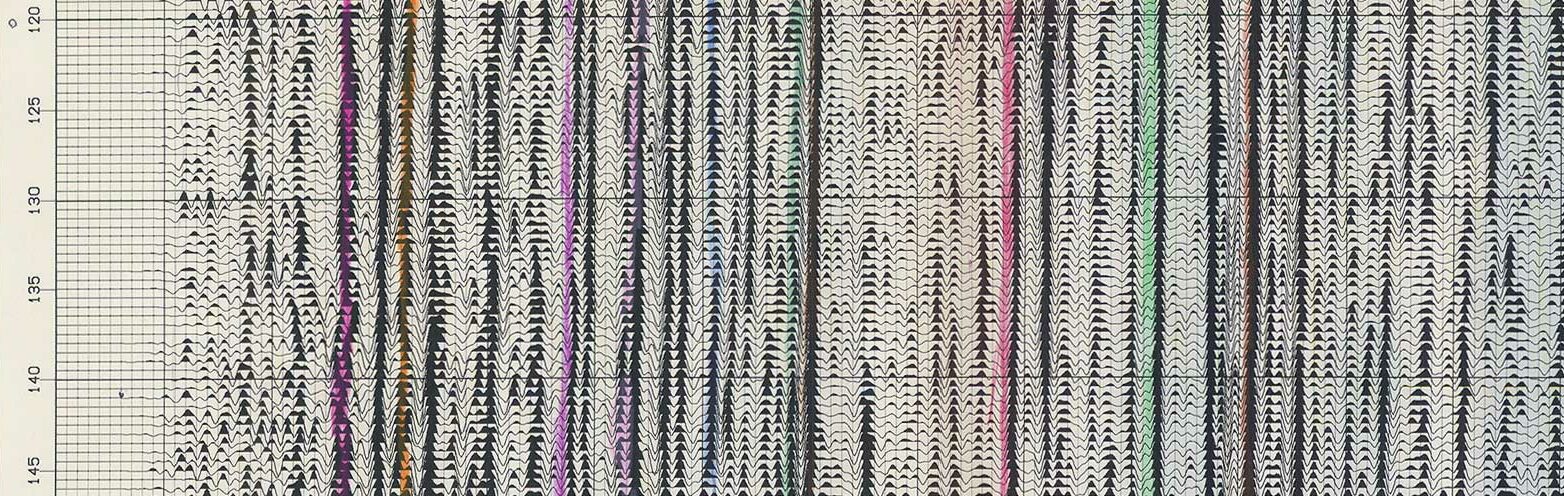
This image is used for illustrative purposes only and does not represent operations or assets of Entreprise Tunisienne d’Activités Pétrolières.
Solution
Ovation Data ran parallel on-site workflows for seismic media transcription and document scanning.
For the tapes, each cartridge was barcoded, screened against ETAP’s existing inventory, and recovered using Ovation Data’s own transcription hardware and software. Data was preserved in Tape Image Format and then demultiplexed into SEG-Y 32-bit floating-point files. Tapes affected by stiction were stabilized with controlled thermal treatment before reading, recovering data that would otherwise have been lost.
For the documents, scanning ran at more than 2,000 pages per workstation per day across standard, wide, and oversized formats. A 54-inch scanner handled the larger materials, with anything wider than that scanned in two parts and digitally merged. Everything was scanned at a minimum of 300 DPI in grayscale or color, with image enhancement, OCR, and multiple quality control checkpoints applied.
Throughout, Ovation Data worked alongside locally employed Tunisian staff and trained them to operate the transcription and scanning workflows, ensuring expertise remained in Tunis.
The recovered data was integrated into a GIS-based application installed at ETAP, linking digitized files to ETAP’s existing metadata and providing GIS layers for wells and 2D seismic surveys. A geoscientist looking up a specific well can now access all associated logs, reports, and seismic sections from a single screen.
Transcription at Scale
43,631 magnetic tapes transcribed, covering 244 surveys and 5,194 seismic lines.
Document Digitization
85,821 hardcopy items scanned and indexed, linked to more than 1,200 wells and over 5,500 2D seismic lines.
Data Recovery
95% overall recovery rate on material as old as 50 years.
Locally Trained Staff
Locally employed Tunisian staff trained in transcription and scanning workflows, with a GIS-based application installed on site.
Results
The project was completed on schedule, with final acceptance issued by ETAP on 31 July 2019. Decades of Tunisian exploration data, once readable only by obsolete equipment, are in use again on ETAP’s own systems.
“Decades-old data is rarely lost. It is just sitting in a form no one can use. Recovery is what turns it back into something the business can act on.”
Ovation Data
Find out more about how Ovation handles data
Find out more about how Ovation is a trusted data management partner that has helped thousands of worldwide customers preserve the integrity of their vital information assets.